
“Motivation gets you going, but discipline keeps you growing. That’s the Law of Consistency. It doesn’t matter how talented you are. It doesn’t matter how many opportunities you receive. If you want to grow, consistency is key.”
– John C. Maxwell
This month’s essays use a framework for living life well.

May 2, 2025 – Focus: The Power of Intentional Attention
May 9, 2025 – Clarity – Seeing Life with Perspective

Today, we will explore consistency and why it is a part of the framework of well-being. The compound effect of consistency is one of the most powerful principles in personal development. The principle states that small, consistent actions can result in massive long-term gains over time. Therefore, consistency often beats talent or short bursts of effort. These incremental efforts, though seemingly insignificant at the moment, compound to create dramatic results.
Daily routines are key to making positive changes that stick. It transforms sporadic actions into ingrained routines, making them easier to maintain and more impactful.
In this essay, we will look at a few components and philosophies of consistency: building better habits and designing the life we want. As with all my essays, the goal is to help you expand your thinking and look at life from a different perspective. We will discuss routines and rituals, Stoic philosophy, and positive psychology.
Routines and rituals as a tool
We can build habits through routines and rituals, which provide consistency, predictability, and reinforce our actions. Rituals are intentional behaviors that can give us structure, reduce the mental fatigue of making decisions, and allow us to improve our focus. Routines and rituals can be simple acts like stretching when you get up in the morning, or more complex tasks related to work or creative processes.
Routines make it easier to form habits. A structured routine seamlessly incorporates new habits, minimizing the conscious effort needed to keep them up. In contrast to the practical nature of routines, rituals bring intention and meaning. A ritual, like having a cup of tea before writing, helps to connect an ordinary action into a symbolic action that reinforces commitment. Commitment is what we need to form a strong habit. Because rituals engage our emotions, they imprint habits more deeply, increasing their appeal and longevity. To create, artists and writers frequently use rituals that help induce flow states; the time or location where they work, or do they use background music as part of the flow?
Routine strengthens the connections in our brains, imprinting the habit into our day. By connecting a habit we already have, we can tag the new habit into a seamless routine, changing conscious effort to an automatic habit. When consistency is practiced, our actions become second nature. This structured routine helps us stay on course even when our motivation fluctuates.
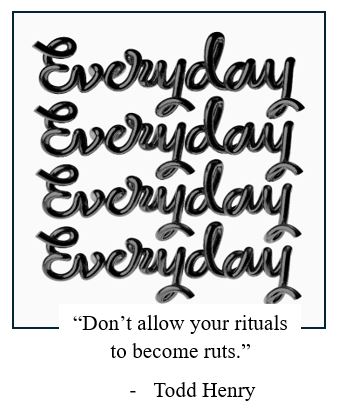
However, we do not want to become so automated that we get into a rut. The saying “don’t allow your rituals to become ruts” means ensuring your routines and habits don’t become monotonous and unproductive behaviors. A rut is a repetitive, unchallenging pattern that can lead to stagnation and a lack of progress, exactly the opposite of our goal.
The power of rituals can be stifled if they become rigid, ingrained patterns; regular reevaluation and adaptation are essential for continued growth. When rituals become ruts, they lose their purpose, rote actions that drain energy and focus.
Review and revise your rituals to ensure they remain effective and don’t become ingrained habits. Are the routines and rituals still helpful? Are they adding value to your personal growth? Evaluate your results, try adding new things, and drop anything that isn’t helpful anymore.
Stoic philosophers and modern psychology
Ancient Stoics stressed consistent daily routines as a key to a flourishing life, achieving eudaimonia. They felt that consistent habits and routines were key to building character, achieving excellence, and handling life’s uncertainties.
Stoicism taught that life is unpredictable, and consistency in our daily habits supports a sense of order and stability. In difficult times, routines and rituals provide a comforting structure. Lucius Annaeus Seneca advocated for a daily practice of reviewing our actions and progress, emphasizing continuous self-examination.
Modern positive psychology and Stoicism share basic principles. Positive psychology believes consistency helps us build healthy habits, achieve goals, and create a positive identity. It underscores the power of small, consistent efforts in building long-term happiness and fulfillment. Both Stoicism and Positive Psychology agree that emotional well-being is improved by consistency. Our long-term success is not about short-term motivation, but a sustained commitment. This psychological school of thought shows that structured rituals promote balance by reducing mental strain. Stoicism teaches that reasoned discipline in thought and action leads to greater wisdom and understanding.

In his book Atomic Habits, James Clear emphasizes that consistency in daily habits is more important than intensity. He argues that making small, consistent improvements is like compound interest and can lead to significant changes. He suggests focusing on building good habits through daily practice and repeating actions, rather than sporadic bursts of effort. Atomic Habits focuses on identity-based habits and links to Stoic character-building.
Clear’s core idea is that small, consistent actions can accumulate over time to create substantial results even if they seem insignificant. He uses the analogy of compound interest; it is not just about growth, but about momentum. Consistent reinforcement of positive actions creates habitual ease, freeing mental energy for advanced cognitive processes. The key is to concentrate purposefully and enhance our mental fortitude.
How to cultivate consistency
Why Consistency is Key to Reaching Your Goals
We can cultivate consistency by setting realistic goals. Start with easily attainable goals that support your core values and long-term objectives. Sticking to a consistent schedule and routine will help you build better habits. Start by adding one or two new habits, then gradually increase. Focus on showing up and doing your best, rather than striving for perfection. Track your progress by regularly monitoring it to stay motivated and adjust as needed. You want productive routines and rituals, so take time to evaluate, ensuring you are not in a useless rut.
Be Consistent!
Create a routine. An example of my morning routine is straightening my bedding, brushing my teeth, feeding the dog, and opening the curtains to let the day in. Then I microwave a cup of tea, and while waiting 3 minutes, I do some morning stretches. I take my cup of tea and open my computer. I am a writer, so my workday begins with two hours of concentrated work. My most productive thinking time is early, when life is still quiet.
I write for an hour, walk my dog for half an hour, then write for another half hour. I find walking restorative for both my mind and body. Having already engaged my mind through focused writing, I can now reflect on subjects or let my thoughts wander as I enjoy nature’s beauty. My most creative thoughts strike when I allow my mind to wander freely. I follow this routine and ritual seven days a week, 365 days a year. The consistency of this practice is how I achieve my goals and creative flow.
Conclusion
Focus – Clarity – Consistency – Moderation – Balance
In our lives, we need to learn to focus on what matters, to use that focus to seek clarity. Once we find clarity in our direction and purpose, we can work on consistency. Building a solid foundation of habits through routines and rituals to automate our general actions, leaving cognitive space for more complex tasks. Our focus should be on what is important, not that our habits are unimportant, but on making habits so automatic that we no longer need to continually decide what to do next and how to ensure things get done. We can create space for the spontaneous, the creativity, the unknown.
Why is consistency so powerful?
“If you are going to achieve excellence in big things, you develop the habit in little matters.”
– Colin Powell
Consistent effort builds momentum, turning hopes, plans, and dreams into reality. Consistent daily action is crucial for habit formation. Repeated small actions will have a significant impact in the long run. The brain’s wiring is enhanced by consistent behavior, resulting in improved concentration, emotional regulation, and adaptability. We are what we repeatedly do; so, these small, consistent actions are who we become. The person who writes every day is a writer, and a person who learns every day gains knowledge.
James Clear suggests that consistent habits can lead to a change in identity. By consistently practicing specific behavior, you can begin to see yourself as someone who does that behavior. Clear proposes the idea of getting 1% better each day. This small, consistent improvement can lead to significant improvement over the year.
Evaluate whether your rituals are serving your purpose. Ask yourself: Do they make my day smoother and more focused? Are they evolving with my needs, or have they become limiting routines?
Recommended Reading
Atomic Habits, by James Clear
The Power of Habit: Why We Do What We Do in Life and Business, by Charles Duhigg
The 7 Habits of Highly Effective People, Stephen R. Covey
Citations
Photo by Resource Database on Unsplash
Photo by Clique Images on Unsplash
One thought on “Consistency- The Strength of Daily Habits”